
In less than a decade, the investment manager, which is part of Octopus Group, best known for the Octopus Energy brand, has invested in 22 integrated retirement communities (IRCs), which together have a combined gross development value (GDV) of more than £2.1bn.
For Kevin Beirne, head of retirement at Octopus Capital, investing in the later-living market makes sense simply because of its “ability to deliver”.
With the over-65 population expected to rise from around 12.5 million to about 14.2 million by 2034, Octopus Capital argues that the retirement market has some of the strongest fundamentals of any residential asset class.
And while Beirne won’t be drawn exactly on the returns its retirement living schemes will deliver, he points out that Octopus Capital’s established care homes fund has “consistently delivered high single-digit core returns”.
However, he says the later-living sector is quite a “nuanced market” compared with other parts of the real estate sector and therefore having “someone who can really understand and read the market is quite crucial to being successful”.
Projects that Octopus Capital has backed include Rangeford Villages’ Strawberry Fields, a 147-home scheme in Stapleford, Cambridge; and Stanbridge Earls, a 155-home development near Romsey in Hampshire run by developer Audley Group.
The IRCs have been mainly funded through two managed funds: the UK Retirement Living Fund, where Octopus Capital acts as an adviser to fund manager Schroders Capital; and Senior Living Investment Partners (SLIP), which it manages in conjunction with Pension Insurance Corporation (PIC).
There is some indication that if you’re in the midpoint pricing, sales have kept up
In addition, Octopus Capital funds Rangeford schemes through a separate managed vehicle.
Beirne concedes that the current market conditions have been less than optimal for the later-living sector. “We have seen broadly the same challenges that housebuilders are facing when you come to sell retirement living [properties],” he says. “If I see a housebuilder’s number of sales per month go down, you probably will see the same impact on retirement living.”
But importantly, Beirne adds, the picture is far from universal, citing the example of its partnership with Rangeford. He explains that the operator’s monthly sales are tracking close to business plan despite the challenging conditions. “In a way, it’s remarkable how resilient the sales numbers have been,” he says.
Set your target
The reason Octopus Capital-backed schemes are doing so well is because the properties are targeted at the mid-market, offering high-quality accommodation and a range of onsite amenities, but not at high-end prices. Properties on sale at Rangeford sites start at £160,000 for a one-bedroom apartment at Wadswick Green in Corsham, Wiltshire, rising to £882,000 for a three-bed apartment at Strawberry Fields.
“There is some indication that if you’re in the midpoint pricing, sales have kept up – and people are having to work harder where you’re in the prime or super-prime numbers,” says Beirne. “We’re not so invested there.”
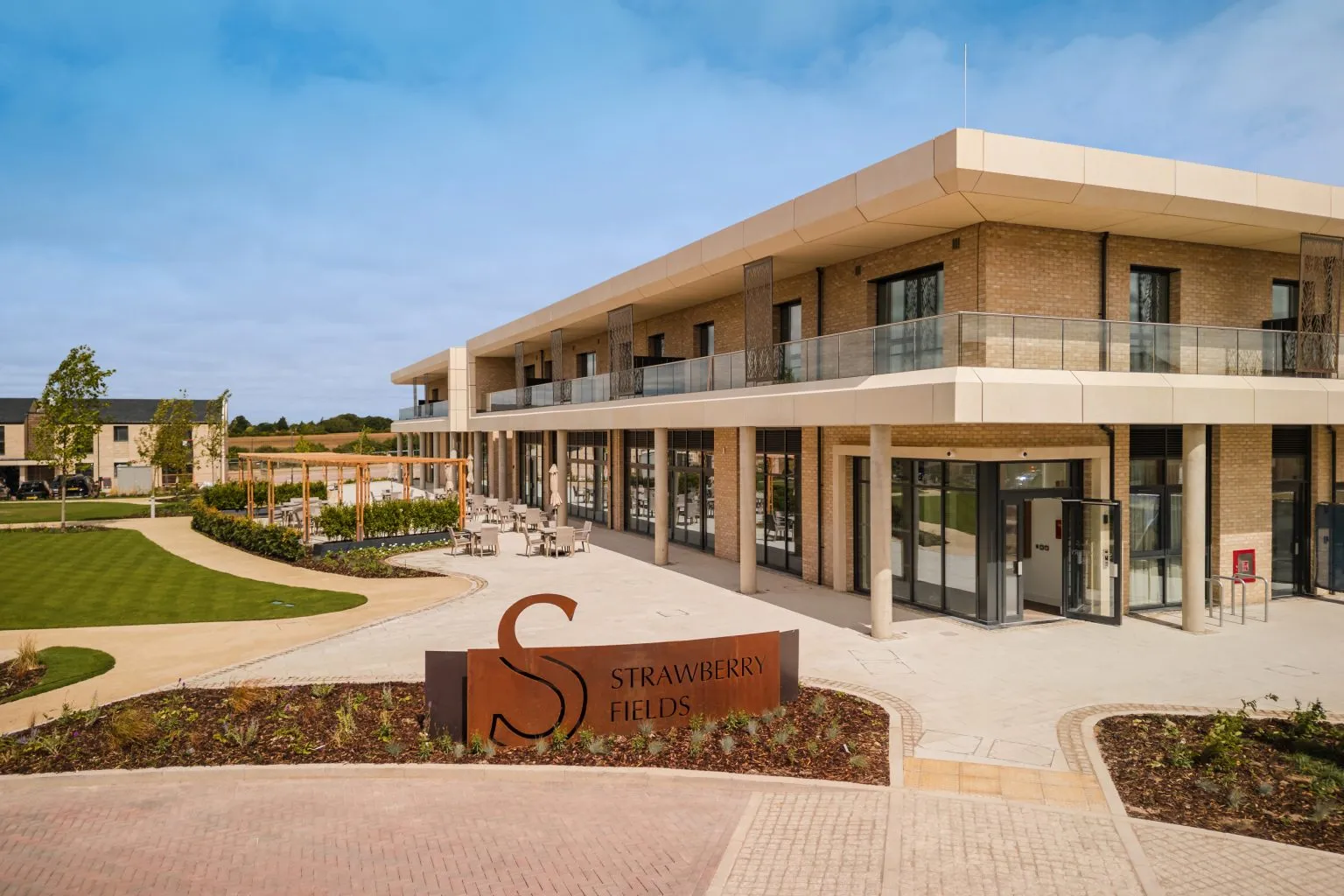
Modern living: Octopus Capital’s investments include Rangeford Villages’ Strawberry Fields in Cambridgeshire
In February, the later-living sector faced its latest reputational bashing when BBC News published an article on its website alleging that some families had been left thousands of pounds out of pocket after struggling to sell retirement properties inherited from family members. Leading retirement accommodation provider McCarthy & Stone came in for particular criticism.
Beirne says he understands the consumer frustration surrounding how the later-living model often works, but he adds that mainstream news stories often fail to consider the broader picture in the market.
“I’ve been around a couple of McCarthy & Stone schemes and talk to their team from time to time,” he says. “I understand their product and I think it does deliver a real service. Quite often what people are missing is the huge number of customers with McCarthy & Stone who would say actually this has been a really important part of my retirement. The actual product is really solid. It’s important that we don’t lose sight of that.”
That said, the story does highlight the ongoing challenge of delivering the type of accommodation that older people want today, says Beirne.
To date, most retirement accommodation built by private developers has been placed on the for-sale market, despite a significant number of older people either not wanting to buy property in later life or being unable to afford it.
“I think there is an analysis that sometimes tenure type becomes the challenge rather than the product itself,” he says. “Rather than criticise [particular operators] for resales, which perhaps they don’t have control over, we as a sector should say ‘do we think that we’ve got the tenure type right across different elements of retirement living?’”
The fact that properties continue to sell strongly at Octopus Capital-backed developments proves there remains a market for retirement homes when the proposition is right, says Beirne, but he adds that it is also true that rental needs to play a “bigger part of the retirement living story”.
“While rental is not without challenges, it has much less friction, especially when someone moves on,” he explains.
Sale or rent?
So, does this mean that Octopus Capital will start backing more rental retirement schemes in the future? Beirne remains confident that the retirement living sector will continue to be a “mixed economy”, requiring both for-sale and rental properties.
However, he adds that Octopus Capital is in the process of devising a rental strategy and, as part of that, it is investigating whether the rental model could work in areas where sales haven’t taken off, such as parts of the country with lower-than-average house prices.
“There is potentially a much bigger number of people who could afford to rent because, generally speaking, a good part of the older population has got access to things like defined-benefit pension schemes as well as state benefits and have an existing family home,” according to Beirne.
“The number of qualifying customers who could afford to rent without losing any of the value in their current family home can often be as much as 50%,” he explains. “Whereas on the same measure for for-purchase, it might be 25% or less.”
There is potentially a bigger number of people who could afford to rent
However, delivering successful rental properties in the retirement market is more complex than just rebadging for-sale homes, he believes. With rental, he says, “the devil is in the detail”.
“In France, there is a relatively well-established rental retirement living model,” he adds. “But the one thing you’ll notice straight away is the floorplates are much tighter.”
From an investor and operator perspective, that probably means “you need to start with the right real estate that’s designed as rental from scratch”, Beirne says.
In terms of the size of the retirement developments, he believes the current sweet spot is around 80 to 150 units. “Once you get below about 80 units in either for-sale or rent it can become more challenging,” he says. “Having said that, our most successful village with Rangeford is just completing its third phase, which will bring it to 248 apartments.”

An emerging trend in the later-living space is the inclusion of retirement accommodation in major urban regeneration schemes. Whereas retirement accommodation has traditionally been built on the outskirts of towns and cities where land is more abundant and, generally, cheaper, a new generation of schemes is being constructed in the heart of communities.
Octopus Capital has “partly led the way”, Beirne argues, after its joint SLIP fund backed Audley’s 148-unit retirement scheme at Brent Cross Town, the £4.5bn regeneration scheme led by Related Argent in north-west London.
He describes Plot 22, as the Audley site is currently known, as a really exciting opportunity. “We’ve long lobbied stakeholders in the sector to incorporate retirement living into their masterplans,” he says. “It makes it much easier for us as an investor to invest because a lot of the issues such as infrastructure and Section 106 obligations are dealt with in the masterplan. So, you are looking at the specific development rather than having to negotiate all the detail.”
The fact that the development at Brent Cross Town is located near established residential areas such as Hampstead, Golders Green and Finchley suggests it will have a large qualifying customer group once completed.
But Beirne doesn’t necessarily believe that every regeneration scheme should include retirement housing, because “older people have a particular viewpoint around what works for them in terms of an urban sphere”.
Overall, he remains convinced in the growth potential of the later-living market. He points out that less than 1% of older people currently live in retirement communities in the UK, which is considerably lower than in countries such as Australia and the US. “That’s why we think it continues to be a compelling opportunity not just in the UK, but across the wider European arena,” he says.
Despite later living remaining a relatively niche part of the property investment market, Beirne believes more large investors are starting to take the subsector seriously.
“I’ve been speaking to a lot of investors over the past 12 months or so,” he says. “It’s very common now to find some of the really well-known names to have senior living as an area that they are researching and actively working on.”
It is no longer a question of whether to move into the later-living market, says Beirne, but more of selecting the right investment model. “There is a macro opportunity here to invest,” he concludes.